1. Blog
  2. Article

Amrisha Prashar
on 4 February 2016

#UbuntuAtMWC Competition
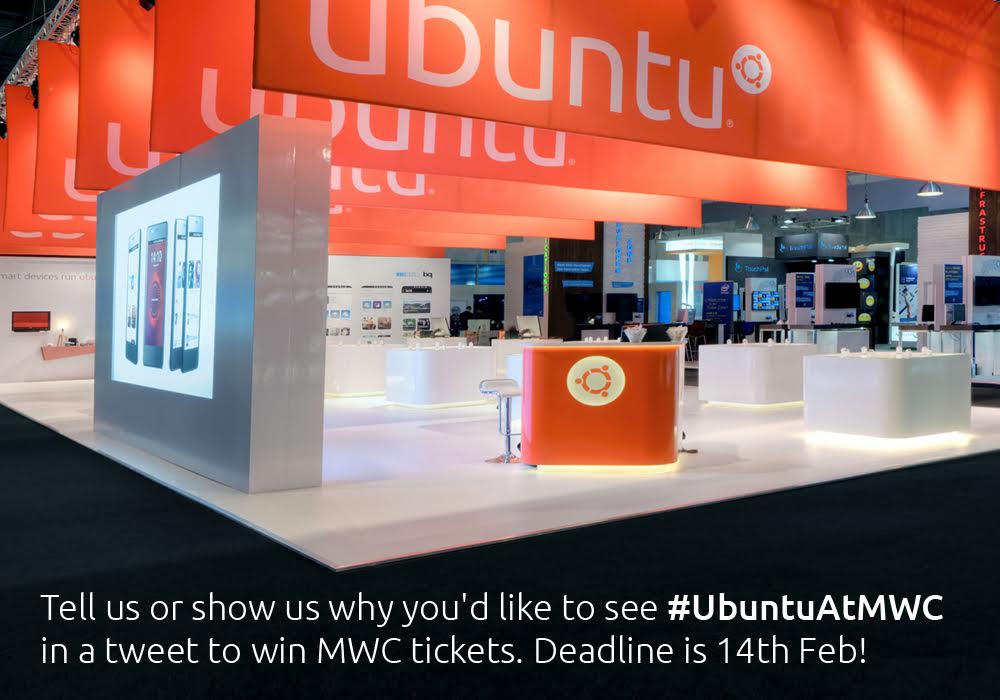

We’re really excited about MWC this year and can’t wait to showcase the various demos across Cloud and Devices!

For those of you not going we’d love to offer you the chance to come and join us and see what we have on display – as our presence is even bigger and better than last year.

To win tickets to MWC we’d like you to tell us or show us why you want to see Ubuntu at MWC in a tweet! Feel free to be as creative as possible with text, images, GIFs or even videos and add the hashtag #UbuntuAtMWC so we can track your awesome entries. The competition starts on 4th Feb (17:00 GMT) and finishes just before the stroke of midnight on Valentines day – 14th Feb (23:55 GMT.) Our creative team will judge the entries based on originality and select three winners where we’ll contact you via Twitter.

Happy creating and we can’t wait for your entries!
Terms and Conditions #UbuntuAtMWC

Related posts


Freyja Cooper
5 June 2026

Beyond tokens per watt – using Ubuntu 26.04 LTS for AI

AI Article

Tokens per watt (TpW) – the measure of useful AI work produced per watt of energy consumed – is the metric at top of mind for CEOs, heads of AI, and infrastructure teams alike. With the tremendous cost of GPU clusters, extracting as much value as possible from the expense is critical. But in the ...


Gabriel Aguiar Noury
4 June 2026

A look into Ubuntu Core 26: Deploying AI models on Renesas RZ/V series for production

Internet of Things Article

Welcome to this blog series which explores innovative uses of Ubuntu Core. Throughout this series, Canonical’s Engineers will show what you can build with our releases, highlighting the features and tools available to you. In this blog, Asa Mirzaieva, engineer from the Silicon Alliances team, will show you how to deploy optimised AI model ...


Jon Taylor
3 June 2026

RISC-V profiles – why is RVA23 significant?

Ubuntu RISC-V

Introduction One of the important offerings of the RISC-V Instruction Set Architecture (ISA) is the ability to customize and extend the base instruction set. An initial reaction to hearing this is often to worry about software portability and compatibility, since if every RISC-V CPU  offers a slightly different set of instructions, softwa ...